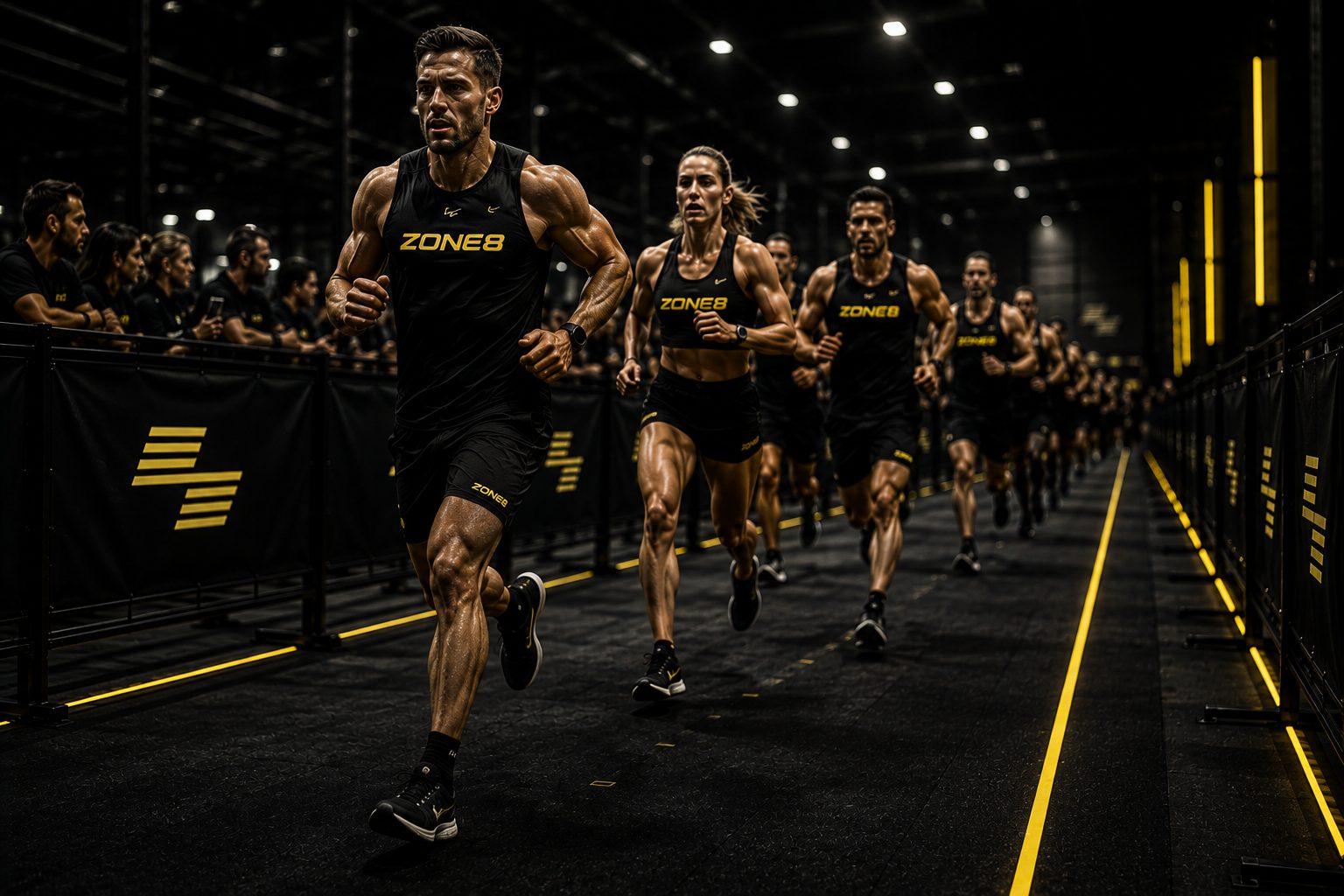
What stays identical between the two categories
Whether you choose Open or Pro, the race format doesn't change: still 8km of running split into 8 x 1km segments, alternated with the same 8 stations, in the same order. The running distance, the number of movements, and the overall structure of the event remain identical between categories.
What actually distinguishes the two categories is the load applied on the relevant stations — and that's a difference far from trivial. Understanding precisely what changes (and what doesn't) helps you make an informed choice rather than a default one based on habit or assumption.
The real difference: the loads
The Pro category applies the discipline's historical reference loads on the relevant stations (Sled Push/Pull, Farmers Carry, Sandbag Lunges, Wall Balls), considerably heavier than those in the Open category. The Open category offers reduced loads, designed to make the format accessible to a wider audience, without removing all physical demand from the event.
This load difference isn't symbolic: it fundamentally changes the nature of the effort required, particularly on pure strength stations, where technique alone can no longer compensate for a lack of real strength. An athlete who perfectly masters a station's technique in Open can find themselves limited by the load itself when moving to Pro, regardless of their movement mastery or years of practice.
Quick comparison table
| Criteria | Open | Pro |
|---|---|---|
| Race format | Identical | Identical |
| Station loads | Reduced | Reference loads, heavier |
| Level required | Accessible with no prerequisite | Developed functional strength needed |
| Typical audience | Discovery, first races | Experienced athletes, performance-focused |
Can you sign up for Pro without experience
Technically, nothing prevents registering directly for Pro, regardless of experience. No prior qualification is required. But in practice, facing significantly heavier loads without specific adapted preparation can turn a first race into a very uncomfortable experience, even a risky one if technique isn't sufficiently mastered for these loads.
This is a decision to make with full awareness, not out of overconfidence or comparison with other athletes whose preparation journey differs from yours. Taking the time to test before choosing saves you from real disappointment on race day.
The Open category isn't just for beginners
A common misconception assumes Open is only for complete beginners, and that progressing automatically means moving to Pro as soon as possible. In reality, many experienced athletes deliberately choose to race Open, particularly to focus on optimizing their race time and transitions rather than managing a maximal load, or simply because this format genuinely suits their personal goals better.
How to know if you're ready for Pro
Rather than relying solely on your general sense of fitness, the most reliable approach is to concretely test the reference loads for each station you're unsure about, in training, under conditions close to race conditions. If you can perform the movements with clean technique and a load close to Pro standards without excessive degradation, that's a good indicator this category is becoming accessible to you.
Conversely, if certain loads remain out of technical or physical reach during these tests, there's no rush: progressing in Open while building the necessary strength remains a perfectly valid strategy, and often more satisfying than a first Pro experience lived in difficulty. A realistic test always beats an optimistic guess made from the couch.
Can you switch categories from one race to the next
Yes, nothing prevents racing Open for a first race and then attempting Pro on a following one, once strength level is judged sufficient. Many athletes actually follow this natural progression, rather than aiming for Pro from their very first participation.
The special case of Doubles and Relay formats
This Open/Pro distinction also applies to team formats. A pair or team can choose to race Open or Pro depending on the group's collective level — and it isn't necessary for all team members to be at the same individual level to make this choice together. This is often an opportunity for a less experienced athlete to discover loads closer to Pro, carried by team dynamics and effort sharing between teammates. This shared-effort dynamic makes Doubles a genuinely different calculation than deciding solo.
The psychological factor in choosing your category
Beyond the purely physical readiness question, how you'll feel mentally on race day matters too. An athlete who enters Pro underprepared often spends the race managing frustration and comparison with faster competitors, which can overshadow the achievement of simply finishing. An athlete who enters Open well-prepared, by contrast, often walks away with a genuinely positive experience and real motivation to keep progressing toward Pro on their own timeline.
There's no objectively "better" choice here — only the choice that sets you up for the experience and outcome that actually serves your longer-term relationship with the sport.
The most common mistakes in this choice
- Choosing by social comparison — registering for Pro because friends or athletes followed on social media do it, without having actually tested the corresponding loads
- Underestimating the real load gap — many athletes discover the scale of the difference only on race day, having never tested Pro loads in training beforehand
- Staying Open out of excessive caution — conversely, some athletes largely ready for Pro stay in Open out of lack of confidence, when a concrete load test would have confirmed their capability
- Switching categories at the last minute — changing your category choice right before the race, without readjusting your race strategy accordingly, often disorients more than it helps
How to orient your preparation based on your target category
If you're targeting Pro, your preparation needs to include real strength work on loaded movements, with regular load progression toward the category's standards. For Open, focus can stay more on general endurance and technique, with strength work still present but less central. Our Hyrox beginner preparation guide details how to structure this progression based on your goal.
Prepare for the category that suits you
ZONE8's free program adapts to your real level, whether you're targeting Open or progressing toward Pro.
Start FreeFAQ
Can you sign up for Pro without experience?
Technically yes, no qualification is required. But heavier loads make this category very demanding without adapted preparation.
Is Open reserved for beginners?
No, many experienced athletes choose Open to focus on their race time rather than raw load.
Can you switch categories from one race to the next?
Yes, nothing prevents racing Open and then attempting Pro on a following race.
Go further
Hyrox Doubles: how to choose your partnerHow to improve your Hyrox race timeHyrox pacing: the strategy that avoids the collapse Online Hyrox Coach →Personal Hyrox Coaching →This content is provided for informational purposes and does not replace the advice of a healthcare professional or certified coach.